Saturday, May 28, 2011

Brown Paper Wrapper


Last month I received a solicitation to subscribe to the Gay and Lesbian Review. As much as I love magazines I don't spend a lot of time searching for new ones so this was the first time I'd run across G&LR.  We've been long time subscribers to The Advocate, but I'd recently let the subscription expire (simply because I'm really bad remembering to follow through on such things these days) and I thought maybe I'd give G&LR a shot for a change of pace.  I was pouring over the information provided, when at that bottom of one flyers I read:


"All correspondence sent in a plain envelope."

I seriously just about blew my top.  My daughter was sitting with me at the time and can attest to the rant that followed.  This of course is nothing new.  My Advocates had come wrapped and I was just as annoyed. And yes, at least with The Advocate, there is an option to decline the wrapping (I tried once, something went wrong at the website and well let's just say it went the way of my intention to renew the subscription).

But that's not the point.  This is not porn.  There is nothing on the cover of these magazines that wouldn't grace the cover of Cosmo or GQ. Nothing from which we need to shield the eyes of the innocent.  The entire purpose of this "plain envelope" was that I would not be outed as being LGBTQ or an ally to... who?  My mail carrier?

And yes I do understand the historical context.  I have family members who lived in openly gay relationships before I was born.  I am forever grateful to the pioneers who created these publications in times and places where it wasn't safe to do so.  I'm glad that they can be discreetly received by those who in this time are still not in a place where it is safe for them to do so.

My question is Why the bloody hell isn't it safe for them to do so?!

Ok so that is mostly a rhetorical question. Only because I know the answer is far to complicated to articulate here. 

Seriously folks.  Those that would like to see the LGBTQ "lifestyle" disappear back into the closet are pretty consistent in their complaints that said "lifestyle" is being foisted on them and their family.  And that there (generally speaking) conservative Christian "lifestyle" is under attack.  But when was the last time any of these people had their issue of  Faith and Family or Focus on the Family's Thriving Family offered to them in a plain envelope for discretion?

Tuesday, May 17, 2011

Children in the Public Sphere

So this is  my looooong overdue follow-up post to my query regarding "cultural differences" in the appropriateness of babies in the public sphere.

So the context - I was at a workshop for board members of nonprofit organizations, working the registration table.  One of the women - who I will assume was a board member of her nonprofit organization - came with her infant who looked to be just under the age of one.  She brought him in a stroller, had a bottle to feed him with (that of course is a whole different discussion, but just making the point that this was an objection to the presence of an infant, not anything like :::gasp::: nursing in public), some snack foods and some quiet toys.  When she registered and entered the room the child was quiet.  There were several other folks working the registration table with me, some who had children, others who did not. Their unanimous opinion was that the very existence of the baby in this public space was inappropriate. 

Ultimately the mom decided she was not able to keep the baby happy enough that she felt comfortable staying.  I held the little guy while she used the bathroom before she left and she mentioned that she was not the original board member who was planning to come, but that she had been asked to fill in at the last minute and then was not able to find childcare. Non of which is particularly relevant except that it is a story so many women (or men) who act as the primary caregivers of their children can tell - childcare is unavailable or unusable because of a non-separating child.

So here is where I am going to go with this post - I think that this type of attitude acts as a form of political oppression, usually for women (but again also for men who act as the primary caregivers).  We have all heard/read the statistics about number of women who are active in public or political life - many fewer than men.  We also see the examples of women who do "make it" - often women who are childless or have one or two children and utilize non-family care for their children (or the extremely rare situations where a second parent is the "stay-at-home" home parent, but I honestly cannot think of a single public example of that situation.  If you can please share!).  In other words, women who are relieved of their role as "mother".  


European Parliament member Licia Ronzulli of the Group of the European People's Party has her baby in a wraparound baby carrier as she participates in a voting during the plenary session of the European Parliament in Strasbourg, 11/29/10

Now before anyone assigns motivation that I do not have, I am *not* arguing for biological determinism.  I do however feel that available scientific evidence indicates that there are specific biological roles that mothers can play during infancy that are extremely difficult if not impossible to reproduce and I believe that by pretending otherwise we are thumbing our noses at everything we know about natural evolution and adaptation. I also believe (as evidenced by the premise of this blog) that raising children, particularly infants and toddlers, in large institutional group settings is a grand cultural experiment with what appear to be less than promising preliminary results.  

But let's just talk about women and choices.  I've tried writing this paragraph a dozen different ways and I cannot put it together without sounding like a list of judgments, so bear with me and assume I'm making a literary point somewhat clumsily.... Can women be happy and fulfilled without having children - of course!  Is a woman less of a woman or a mother because she would choose to have someone else do the majority of the primary care of her children (partner, other family member, paid help, whatever) - of course not!  And is it okay for women to have children (avoiding for the moment any arguments about over population, anchor babies, families who receive public assistance, and the like) - I'm guessing most would also say yes.  And if a woman wants to be the primary caretaker of her children is it okay that she make that choice (again avoiding the wedge issue political arguments) - again I think most would say yes (ignoring the Linda Hirshmans of the world).
Roselle Park Councilwoman Larissa Chen-Hoerning, with her newborn son, Enzo, discusses an ordinance with Councilman Modesto Miranda at a council meeting earlier this month. 3/14/10
So why is only one half of this group (women without children or women who are not primary caretakers) considered to have any value to public discourse?  Does that act of care taking render parents unable to make intelligent contributions? Is the sensibilities of the rest of society so fragile that they would find it impossible to comport themselves normally if a child were in their midst? What are the consequences when we tell women (parents) that they have to choose between the care of their children and our willingness to allow them to contribute to the world beyond their family walls.  In this sense it is not the act of care taking which is marginalizing, but the attitudes towards care taking. Do the women pictured above look incapable of carrying out their duties? Do you know how hard it is to find pictures of women (or men) with babies in public forums? 

It is notable that in many other countries women play a much larger role in governing.  There are all sorts of differences that come into play - greater government support for both family care taking and non-family care takers, closer family and community ties and political seats set-aside for women representation.  But I also have to wonder about the fact that in many other parts of world children are expected to actually be part of the world.  They are contributing in substantial ways (unfortunately sometimes to the determent of the child), but often they are just doing the things that children do.  And their presence is not considered unusual or problematic. How freeing is that to the women in those places - if children do not have to be isolated then women (as the most usual primary caretaker) do not have to be isolated either.  How would that change things here?


Thursday, April 14, 2011

Cultural Differences?

Just a quick question and I will expand more later, but I'm wondering how others feel about children in the public sphere.  For example bringing a baby to a public group training/lecture?

My husband hates it when I ask for an opinion about something that I have an opinion about without stating my own opinion - so... for the record I am in favor of children in public spaces.  I understand that continuous loud noise is a problem, but I think that short quiet noises should not be viewed differently than someone blowing their nose, opening a cellophane candy wrapper, or having their phone vibrate across the table.

I'm asking because I was recently in the minority of one on this topic and was wondering if I was simply coming from a more "AP" perspective or if I was a total loon ;-).

Wednesday, April 13, 2011

Tuesday, April 12, 2011

A journey to compassion and connection

Welcome to the April Carnival of Natural Parenting: Compassionate Advocacy
This post was written for inclusion in the monthly Carnival of Natural Parenting hosted by Code Name: Mama and Hobo Mama. This month our participants have shared how they advocate for healthy, gentle parenting choices compassionately. Please read to the end to find a list of links to the other carnival participants.
***


Lecture en famille by Mypouss 
Lecture en famille, a photo by Mypouss on Flickr.


Never having been much for confrontation, "compassionate" advocacy has generally been my default.  However, the place from where that "compassion" comes has changed through the years.  In the beginning of my parenting journey I often thought that those who chose differently than I did were simply ignorant.  They didn't understand how important it was to breastfeed, or how wonderful it was to wake up next to a sleeping toddler, or the research on punishments and rewards.  My advocacy would often take the form of sharing information, sometimes (often?) in excess of what the other person would want.  

As part of my training to become a La Leche League Leader I had to participate in something called a bias exercise.  It is exactly what it sounds like - the Leader Applicant (Leader in training) has to think of choices that mothers may make with regards to breastfeeding that they would have a bias against and then work through their own issues to help these imaginary mothers. Depending on the Leader Applicant's pet issues this may have something to do with sleep training, early weaning, extended separation or something else entirely.  I dutifully completed the exercise, but it wasn't until I starting working with many mothers, in many situations that I slowly began to understand the complexities that go into making parenting decisions.

During this time I also began to study non-violent communication which holds as one of its guiding principles the awareness of, and eventually the avoidance of judgments.  NVC also teaches that all actions are simply strategies to meet needs and that while we all have the same basic needs at any given point in time some needs take priority over others. Finally I had a frame in which choices that were different from mine made sense.  For whatever reason my logic obsessed brain found it much easier to extend true compassion when I had understanding.

I feel very fortunate that I was able to make that leap because it is a connection that I seek to make on a nearly daily basis.  Currently I am working as an IBCLC in a local hospital. I also teach hospital based childbirth education, breastfeeding, and newborn care classes.  I forget how far out of the "mainstream" our choices are until I am interacting in these settings and then I remember that the vast majority of peple make very different choices for their families than we do for ours. However,  I also feel excited about the opportunity to advocate for a different way of understanding our relationship with children.

I do still share information.  In classes I mention the precipitous decline in circumcision rates, the physiological instability that comes from separating mothers and newborns, and the difficulties that can arise when we introduce labor and birth interventions.  To new families I caution that the first two weeks are critical for establishing long term milk supply and that babies who are not feeding well at the breast may further struggle after getting a bottle.  However, especially once that baby arrives, I ask more questions than offer lectures.  I listen to feelings and their underlying needs and seek to help parents to get those needs met.  

SAKURAKO @ Breast feeding by MJ/TR (´・ω・) 
SAKURAKO @ Breast feeding, a photo by MJ/TR (´・ω・) on Flickr.

When breastfeeding feels scary or overwhelming or is painful and stressful there is no benefit in telling mom that it isn't or that it shouldn't be or that it won't be.  Either she dismisses me or she doubts herself, neither of which allows me to be much of an advocate for anybody or anything.  Instead we talk about those experiences that are common, how well she knows her baby and herself, and how she is her baby's whole world. We talk about her goals, her concerns, her challenges.  I offer resources and options - but more than anything else support.  

The more I consider this whole attachment parenting thing the more I realize it isn't about a set of behaviors that parents engage in, but instead it is about connection.  Connection flourishes in a state of trust and while many of the things we advocate through AP practices promote trust, they are not the only things that can build trust.  When I attempt to demonstrate that I trust other parents and show them how much their infant trusts them and that they are deserving of that trust I believe that that groundwork does more to extend compassion than beating someone over the head with the benefits of breastfeeding.  Don't get me wrong, in my perfect fantasy world all babies would thrive on mama's milk. But whether that baby is nursed for three years or receives formula at three hours, if this circle of compassion, trust, and connection can continue to flourish that is what I truly believe will benefit parents and children and ultimately all of us. 


***
Carnival of Natural Parenting -- Hobo Mama and Code Name: MamaVisit Code Name: Mama and Hobo Mama to find out how you can participate in the next Carnival of Natural Parenting!
Please take time to read the submissions by the other carnival participants:
  • Natural Parenting Advocacy by Example — Jenn at Monkey Butt Junction uses her blog, Twitter and Facebook as her natural parenting soapbox.
  • You Catch More Flies With Honey — When it comes to natural parenting advice, Kate of The Guavalicious Life believes you catch more flies with honey.
  • From the Heart — Patti at Jazzy Mama searches her heart for an appropriate response when she learns that someone she respects wants his baby to cry-it-out.
  • I Offer the Truth — Amy at Innate Wholeness shares the hard truths to inspire parents in making changes and fully appreciating the parenting experience.
  • Advocating or Just Opinionated?Momma Jorje discusses how to draw the line between advocating compassionately and being just plain opinionated. It can be quite a fine line.
  • Compassionate Advocacy — Mamapoekie of Authentic Parenting writes about how to discuss topics you are passionate about with people who don't share your views.
  • Heiny Helpers: Sharing Cloth Love — Heiny Helpers is guest posting on Natural Parents Network to share how they are providing cloth diapers and cloth diapering support to low income families.
  • Struggling with Advocacy — April of McApril still struggles to determine how strongly she should advocate for her causes, but still loves to show her love for her parenting choices to those who would like to listen.
  • Compassionate Advocacy Through Blogging (AKA –Why I Blog) — Jennifer at Hybrid Rasta Mama shares how both blogging and day-to-day life give her opportunities to compassionately advocate for natural parenting practices.
  • A Letter to *Those* Parents — Zoie at TouchstoneZ shares how to write an informed yet respectful reply to those parents — you know, the ones who don't parent the way you do.
  • Why I Am Not A Homebirth Advocate — Olivia at Write About Birth is coming out: she is a homebirth mom, but not a homebirth advocate. One size does not fit all – but choice is something we can all advocate for!
  • Why I Open My Big Mouth — Wolfmother from Fabulous Mama Chronicles reflects on why she is passionate about sharing parenting resources.
  • Watching and Wearing — Laura at Our Messy Messy Life advocates the joys of babywearing simply by living life in a small college town.
  • Compassionate Advocacy . . . That's The Way I Do It — Amyables at Toddler in Tow describes how she's learned to forsake judgment and channel her social energy to spread the "good news" of natural parenting through interaction and shared experiences.
  • Compelling without repelling — Lauren at Hobo Mama cringes when she thinks of the obnoxious way she used to berate people into seeing her point of view.
  • I Am the Change — Amanda at Let's Take the Metro describes a recent awakening where she realized exactly how to advocate for natural parenting.
  • Public Displays of CompassionThe Accidental Natural Mama recounts an emotional trip to the grocery store and the importance of staying calm and compassionate in the storm of toddler emotions.
  • I will not hide behind my persona — Suzi Leigh at Attached at the Boob discusses the benefits of being honest and compassionate on the internet.
  • Choosing My Words — Jenny at Chronicles of a Nursing Mom shares why she started her blog and why she continues to blog despite an increasingly hectic schedule.
  • Honour the Child :: Compassionate Advocacy in the Classroom — Lori at Beneath the Rowan Tree shares her experience of being a gentle and compassionate parent — with other people's children — as a classroom volunteer in her daughter's senior kindergarten room.
  • Inspired by the Great Divide (and Hoping to Inspire) — Rosemary at Rosmarinus Officinalis shares her thoughts on navigating the "great divide" through gently teaching and being teachable.
  • Introverted Advocacy — CatholicMommy at Working to be Worthy shares how she advocates for gentle parenting, even though she is about as introverted as one can be.
  • The Three R's of Effective and Gentle Advocacy — Ana at Pandamoly explains how "The Three R's" can yield consistent results and endless inspiration to those in need of some change.
  • Passionate and Compassionate: How do We do It? — Kelly at Becoming Crunchy shares the importance of understanding your motivation for advocacy.
  • Sharing the love — Isil at Smiling Like Sunshine talks about how she shares the love and spreads the word.
  • What Frank Said — Nada at miniMOMist has a good friend named Frank. She uses his famous saying to demonstrate how much natural parenting has benefited her and her family.
  • Baby Sling Carriers Make Great Compassionate Advocacy Tools — Chante at My Natural Motherhood Journey shared her babywearing knowledge — and her sling — with a new mom.
  • Everyday Superheroes — Who needs Superman when we have a community of compassionate advocates?! Dionna at Code Name: Mama believes that our community of gentle bloggers are the true superheroes.
  • Words of advice: compassionately advocating for my parenting choices — MrsH at Fleeting Moments waits to give advice until she's been asked, resulting in fewer advocacy moments but very high responsiveness from parents all over the spectrum of parenting approaches.
  • Peaceful Parenting — Peaceful parenting shows at Living Peacefully with Children with an atypical comment from a stranger.
  • Speaking for birth — Lucy at Dreaming Aloud soul-searches about how she can advocate for natural birth without causing offense.
  • Gentle is as Gentle Does — Laura at A Pug in the Kitchen shares how she is gently advocating her parenting style.
  • Walking on Air — Rachael at The Variegated Life wants you to know that she has no idea what she's doing — and it's a gift.
  • Parenting with my head, my heart, and my gut — Charise at I Thought I Knew Mama shares her thoughts on being a compassionate advocate of natural parenting as a blogger.
  • At Peace With the World — Megan at Ichigo Means Strawberry talks about being an advocate for peaceful parenting at 10,000 feet.
  • Putting a public face on "holistic" — Being public about her convictions is a must for Jessica at Crunchy-Chewy Mama, but it takes some delicacy.
  • Just Be; Just Do. — Amy at Anktangle believes strongly about her parenting methods, and also that the way to get people to take notice is to simply live her life and parent the best she knows how.
  • One Parent at a Time... — Kat at Loving {Almost} Every Moment believes that advocating for Natural Parenting is best accomplished by walking the walk.
  • Self-compassion — We're great at caring for and supporting others —from our kiddos to other mamas — but Lisa at Gems of Delight shares a post about treating ourselves with that same sense of compassion.
  • Using Montessori Principles to Advocate Natural Parenting — Deb Chitwood at Living Montessori Now tells how she uses Montessori principles to be a compassionate advocate for natural parenting.
  • Advocacy? Me? — Seonaid at The Practical Dilettante discovers that by "just doing her thing," she may be advocating for natural parenting.
  • Feeding by Example — Mama Mo at Attached at the Nip shares her experience of being the first one of her generation to parent.
  • Compassionate Consumerism — Erica at ChildOrganics encourages her children to be compassionate consumers and discusses the benefits of buying local and fair trade products.
  • The Importance of Advocating Compassionately — Kristen at Adventures in Mommyhood acts as a compassionate advocate by sharing information with many in the hopes of reaching a few.
  • Some Thoughts on Gentle Discipline — Darcel at The Mahogany Way shares her thoughts and some tips on Gentle Discipline.
  • Compassionate Advocacy: Sharing Resources, Spreading the Love — Terri at Child of the Nature Isle shares how her passion for making natural choices in pregnancy, birth, and parenting have supported others in Dominica and beyond.
  • A journey to compassion and connection — Jessica at Instead of Institutions shares her journey from know-it-all to authentic advocacy.
  • Advocacy Through Openness, Respect, and Understanding — Melissa at The New Mommy Files describes her view on belief, and how it has shaped the way she advocates for gentle parenting choices.
  • Why I'm not an advocate for Natural Parenting — Mrs Green at Little Green Blog delivers the shocking news that, after 10 years of being a mum, she is NOT an advocate for natural parenting!
  • Natural Love Creates Natural Happiness — A picture is worth a thousand words, but how about a smile, or a giggle, or a gaze? Jessica at Cloth Diapering Mama’s kids are extremely social and their natural happiness is very obvious.
  • Carnival of Natural Parenting: Compassionate Advocacy — Even in the progressive SF Bay Area, Lily at Witch Mom finds she must defend some of her parenting choices.
  • A Tale of Four Milky Mamas — In this post The ArtsyMama shares how she has found ways to repay her childhood friend for the gift of milk.
  • don't tell me what to do — Pecky at benny and bex demonstrates compassionate advocacy through leading by example.

Wednesday, April 6, 2011

Planned Home vs Hospital Birth: A Meta-Analysis Gone Wrong


That is the verbatim title of a recent article on Medscape. The entire article can be located here. It does require you to create a free account to read the article, but you will also have the opportunity to subscribe to any of there many weekly emails which can help to keep one abreast of the goings on in allopathic medicine. 


The original flawed paper by Joseph Wax et. al. is often used by homebirth opponents and was the foundation of the recent ACOG committee opinion which quoted Wax's now discredited statistic that planned homebirth carriers a two- to three- fold increase in newborn death when compared to planned hospital births.  Homebirth advocates have long been aware of many of the methodological errors. This article not only shares those concerns with a wider audience, it also points out many new faults.


Some of my favorite parts....


The authors of this months article got right down to business.


The statistical analysis upon which this conclusion was based was deeply flawed, containing many numerical errors, improper inclusion and exclusion of studies, mischaracterization of cited works, and logical impossibilities. In addition, the software tool used for nearly two thirds of the meta-analysis calculations contains serious errors that can dramatically underestimate confidence intervals (CIs), and this resulted in at least 1 spuriously statistically significant result.


This one made me LOL.

Planned Home Birth (%)Planned Hospital Birth (%)
Perinatal death
All0.070.08
Nonanomalous0.070.08
Neonatal death
All0.200.09
Nonanomalous0.150.04

Adapted from Wax JR, et al. Am J Obstet Gynecol. 2010;203:243:e1-e8.

Wax and colleagues defined perinatal death as stillbirth of at least 20 weeks or 500 g, or death of a liveborn infant within 28 days of birth. Neonatal deaths are defined as deaths of liveborn infants within 28 days of delivery.[1] With the definitions chosen by these investigators, neonatal deaths are a subset of perinatal deaths. As can be seen in Table 1, however, the investigators' results show that for planned home births, the neonatal death rates are actually far higher than the corresponding perinatal death rates. According to the investigators' definitions, these results are impossible. 


One particular study, authored by Pang was the most significant contributor to the 2-3 fold increased risk statement.  It also appears to be one of the most inappropriate studies to have been included in a meta-analysis purporting to examine the outcome of planned homebirth.


A further indication that unplanned home births are included in the study by Pang and colleagues is the fact that 7.6% of home births in that study were reported as having been attended by physicians, yet during the study period not a single physician in Washington state was known to offer home birth services [emphasis added].[22] Given that Wax and colleagues' stated goal is to compare outcomes of planned home vs planned hospital births, it is extraordinary and incomprehensible that the study by Pang and colleagues was included.


The authors of this report went back and examine the original works included in the meta- analysis as well as works they argue should have been included and weren't.  In addition to inclusion/exclusion errors and statistical analysis a large number of errors in counting were found. 


For example, we point to the study of Pang and coworkers[14] from which, to obtain results found in the summary table, the investigators must have counted 13 nonanomalous neonatal deaths in the home birth group. However, from Table 4 in that paper, it is clear that only 12 deaths should have been included.


I would urge you to read the entire critique.  It is quite damning and frankly frightening that such errors were allowed to go unchecked in such a major publication as the American Journal of Obstetrics and Gynecology


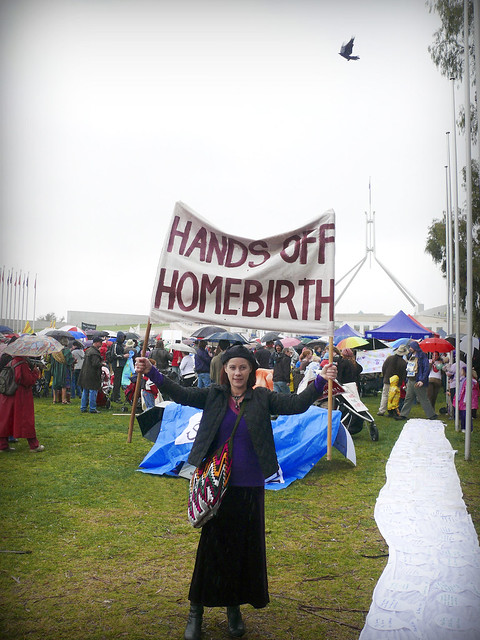
photo

070909 Chani at the Homebirth Rights Rally, a photo by Nico Nelson on Flickr.


Tuesday, March 29, 2011

How many hours in a day?

It has been a particularly crazy several days. In fact I am writing this post when I should be working on others things, but have decided that if I want to write a blog than I'm darn well going to have to carve out time to do it.

For me, the most difficult part of being so busy and having so many roles is the challenge of staying present in any given moment. I once described my life as a perpetual conference with sessions going on at all hours of the day and night and all (or nearly all) of the sessions looked good. Every moment of every day I have to decide which session I am going to walk into. Will it be the student session? Lactation consultant? Working out? Parenting? Homeschooling? Home keeping? Graduate assistant? Wife? Friend? Eating? Sleeping? And what if I just want to hang out in the hall and either take some down time or chat with whoever might be available? Where can that fit in with all of this?

And the kicker is that non of the sessions are recorded or offered in a different time slot - though similar ones may be offered at future points, this is not guaranteed.

To the best of my ability I try to view abundance in time. This is helped when I am able to be deliberate about how I spend my time. Not that every moment has to be "productive" in the protestant work ethic type of way, but that if I am not doing something "productive" it is something that I have decided to be doing. When things come up that feel like they take that control away from - that is when I can really start to panic and feel overwhelmed.

I have not chosen to have every one of these sessions to be part of this conference all at the same time, but at least I am mostly enjoying them all. If I get the opportunity to set some aside for a respite I will take it (certain ones, that is). In the meantime, here I am, trying to figure out which room to go in to next.